
What is BESS? Why Battery Energy Storage is a Game-Changer for Modern Solar
Understand Battery Energy Storage Systems (BESS), how they transform intermittent daytime solar into 24x7 dispatchable clean power, and why BESS makes older generation solar obsolete.
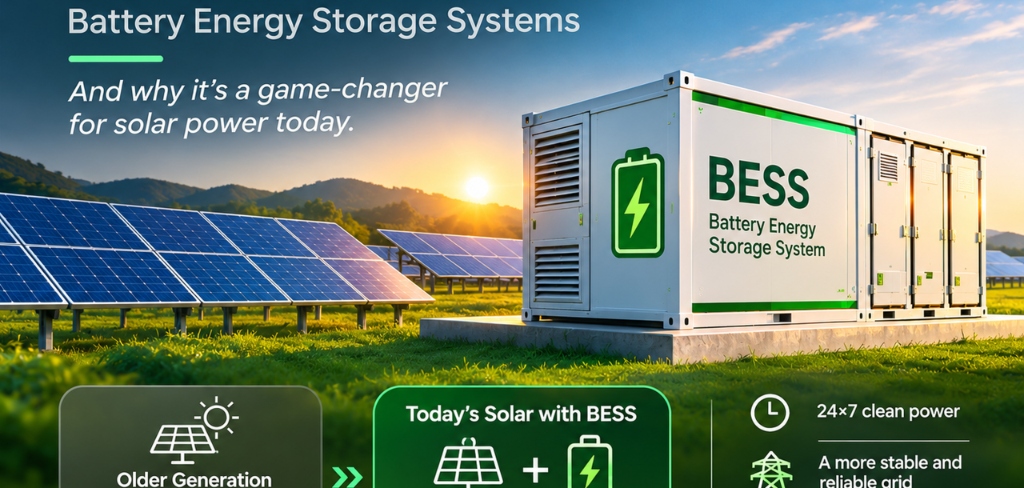
From Intermittent Rays to 24×7 Power: The Rise of BESS
For decades, the fundamental limitation of solar power has been summarized in a single, unyielding sentence: solar panels only generate electricity when the sun is shining.
While older generation photovoltaic installations transformed global energy economics by providing clean, inexpensive daytime kilowatt-hours, they left electric grids grappling with intermittency, evening demand surges, and renewable curtailment.
Today, the rapid maturation of BESS (Battery Energy Storage Systems) is fundamentally rewriting that equation. By pairing high-capacity electrochemical storage with intelligent power electronics, solar is evolving from an intermittent daytime resource into a firm, dispatchable, round-the-clock power source.
Here is an in-depth look at what BESS is, how it compares to older generation solar architectures, and why it represents the future of utility-scale and commercial renewable power.
1. What Exactly is a BESS?
A Battery Energy Storage System (BESS) is an integrated industrial system designed to capture electrical energy from renewable generation (or the utility grid), store it within advanced battery modules, and discharge it when demand or electricity tariffs peak.
A modern, utility-grade BESS consists of four core subsystems:
- Battery Module & Rack Assembly: Dense banks of electrochemical cells—predominantly Lithium Iron Phosphate (LFP) due to its superior thermal stability, extended cycle life (6,000+ cycles), and non-combustible chemistry.
- Battery Management System (BMS): The digital nervous system that continuously monitors cell voltage, state of charge (SoC), state of health (SoH), and internal temperatures to ensure safe, balanced operation.
- Power Conversion System (PCS / Bi-directional Inverter): Converts AC power to DC for charging and converts DC energy back into synchronized, high-quality AC power for grid injection.
- Energy Management System (EMS) & Thermal Controls: An automated intelligence layer that executes charge/discharge schedules based on real-time grid frequency, peak-hour pricing, and factory load curves, paired with liquid-cooling loops for optimal ambient control.
2. Older Generation Solar vs. Today’s Solar with BESS
The contrast between legacy photovoltaic systems and modern solar-plus-storage plants highlights how drastically energy engineering has progressed.
| Performance Metric | Older Generation Solar (Stand-alone PV) | Modern Solar + BESS Hybrid Systems | | :--- | :--- | :--- | | Generation Window | Restricted to daylight hours (approx. 9 AM – 4 PM) | 24×7 dispatchable clean power available on demand | | Grid Reliability | Intermittent; vulnerable to sudden cloud cover ramps | Firm and stable; smooths power output instantaneously | | Evening Peak Support | Zero generation during critical evening peak hours | Discharges stored daytime surplus during evening peaks | | Grid Interaction | Passive feeding; causes the "Duck Curve" and curtailment | Active grid support: frequency regulation & synthetic inertia | | C&I Financial Value | Offsets daytime energy units only | Peak shaving, demand charge reduction, & diesel replacement | | System Resilience | Shuts down during utility grid outages (anti-islanding) | Provides seamless backup & microgrid islanding capability |
3. The Structural Problem with Legacy Solar: The "Duck Curve"
In regions with high solar adoption, older generation solar plants created an operational paradox known across energy utilities as the "Duck Curve":
- Midday Overgeneration: Around noon, solar production surges to its maximum. Because legacy systems cannot store surplus generation, local transmission grids face reverse power flow, voltage instability, and forced curtailment (wasting clean energy).
- The Evening Ramp-Up: As the sun sets, solar generation drops to zero just as domestic and commercial electricity consumption surges to its evening peak. Utilities were historically forced to fire up expensive, polluting coal or diesel "peaker" plants to compensate for the cliff-like drop in solar output.
BESS resolves this paradox completely. Instead of dumping surplus midday electricity or overstressing the substation, the BESS absorbs excess generation and releases it into the grid during peak evening hours—shifting solar energy from when it is easiest to make to when it is most needed.
4. Key Strategic Advantages of Deploying BESS Today
A. Peak Shaving & Time-of-Day (ToD) Arbitrage
Industrial and commercial consumers face steep peak-hour power tariffs and penalties for exceeding sanctioned contract demands. A BESS charges during low-tariff daylight hours or from rooftop solar arrays, then automatically discharges during peak demand periods. This slashes maximum demand charges and optimizes operational expenditure.
B. Grid Frequency Regulation & Millisecond Response
Unlike mechanical thermal turbines that require minutes to spin up, power electronic battery inverters react in sub-second timescales (under 20 milliseconds). When a transmission line trips or grid frequency fluctuates, BESS instantly injects or absorbs active power, stabilizing the wider transmission network.
C. Diesel Generator Displacement
For manufacturing facilities, data centers, and hospitals, BESS paired with solar provides instantaneous, clean backup power, dramatically reducing operating hours and diesel fuel consumption of polluting standby generator sets.
5. The Policy & Market Momentum in India
As India targets 500 GW of non-fossil capacity by 2030, energy storage is no longer optional—it is a national priority:
- Viability Gap Funding (VGF): The central government approved a dedicated VGF framework covering up to 40% of capital costs for 4,000 MWh of BESS projects.
- Round-the-Clock (RTC) & Peak Power Tenders: Central agencies like SECI and NTPC have pivoted procurement towards hybrid tenders requiring guaranteed peak-hour delivery backed by battery or pumped-storage solutions.
- Energy Storage Obligations (ESO): State power distribution companies are mandated to source an escalating percentage of their annual procurement from dedicated storage assets.
6. The Verdict: Solar Has Matured
Stand-alone solar built the foundation of the renewable revolution by proving clean power could be cost-effective. Today, BESS turns that clean power into an uncompromising, dependable utility standard.
At Siret Energy Engineering, our decades of experience in power electronics, off-grid integration, and grid-scale solar enable us to design optimized BESS architectures tailored to commercial, industrial, and utility infrastructure.
Work with SIRET
Planning a renewable energy project?
Talk to our team about solar, storage and grid integration for your home or business.
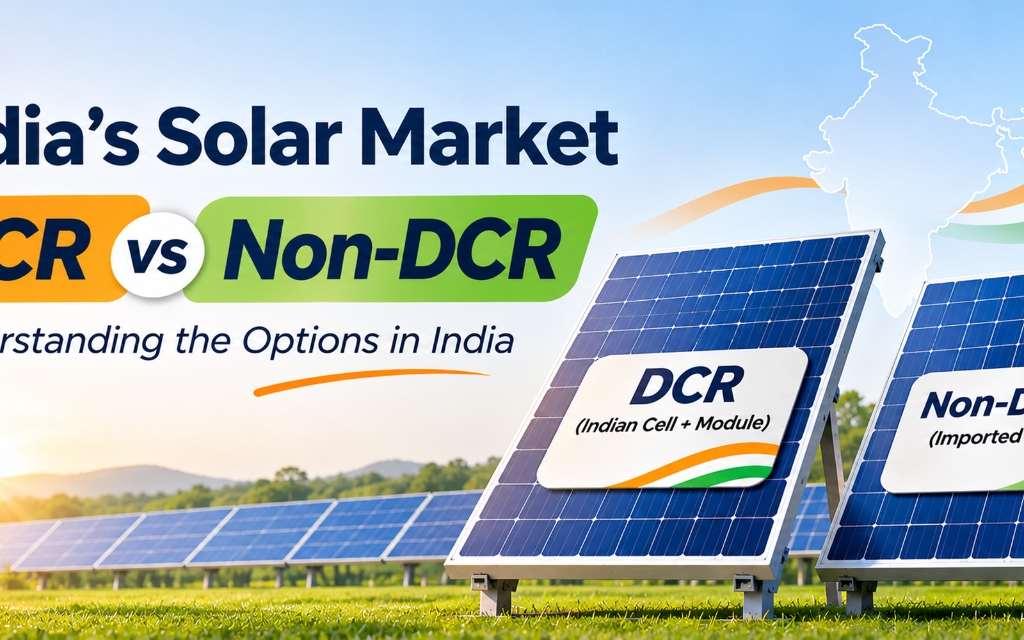
DCR vs. Non-DCR Solar Panels in India: Policy, Costs, and the Supply Dilemma
A comprehensive guide to Domestic Content Requirement (DCR) vs. Non-DCR solar panels in India—explaining policy mandates, pricing premiums, supply bottlenecks, and what developers and homeowners need to know.